When there are mortgage market abnormalities, we must take advantage to get the lowest rate and best terms possible. Recently, there are two mortgage abnormalities to be aware of: 1) The average 15-year mortgage rate is way below the average 5/1 ARM rate. and 2) The average 30-year mortgage rate has been going down while
The post Mortgage Market Abnormalities: Take Advantage To Get The Best Rates appeared first on Financial Samurai.
from Financial Samurai
via Finance Xpress
How I Grew From 0 Subscribers To Over $100,000 On YouTube In Less Than One Year
4:23 AMDo you want to learn how to get started on YouTube? Here’s how Erika went from 0 subscribers to over $100,000 on YouTube in less than one year.
Everyone has heard of YouTube, and pretty much everyone has watched at least one YouTube video in their life.
In fact, according to YouTube, there are over 2 billion users who watch at least one video on YouTube each month.
That is a ton of people!
If you’re interested in starting a YouTube channel, then please read further.
Today, I want to introduce you to Erika Kullberg.
Erika Kullberg is a nationally-recognized personal finance expert and has been featured in Business Insider, CNBC, U.S. News & World Report, the Washington Post and more. Her personal finance YouTube channel has grown to over 70,000 subscribers and 4 million views in less than a year.
Yes, this means that it is not too late to get started on YouTube!
I asked Erika to take part in an interview on Making Sense of Cents about her growth on YouTube.
In this interview, you’ll learn:
- Why she decided to start a Youtube channel
- How she makes money with her YouTube channel
- How her following and income has grown
- What she uses to record, edit, and publish videos
- How long it takes her to make each video
- If she thinks there is room for new YouTubers
And, all of her best YouTube tips!
This interview is packed full of valuable information on how to start a YouTube channel.
You can find Erika’s YouTube channel here.
Related content that you may be interested in:
- How Sailing SV Delos Makes Money on YouTube
- How I Make Money On TikTok – How I Grew To 350,000 Followers and Made $60,000 In 6 Weeks
- How This 34 Year Old Owns 7 Rental Homes
- How Amanda Paid Off $133,763 In Debt in 43 Months
- How One Blogger Grew His Blog to Over 2 Million Visitors In A Year
Here’s how Erika went from 0 subscribers to over $100,000 on YouTube.
1. Tell me your story. Who are you and what do you do?
I’m Erika Kullberg, I’m an award-winning lawyer and the founder of a legal technology company, Plug and Law. I’m also a nationally-recognized personal finance expert and have been featured in Business Insider, CNBC, U.S. News & World Report, the Washington Post and more.
My YouTube channel, where I talk about all things personal finance, has grown to over 70,000 subscribers and 4 million views in less than a year.
I graduated from the University of Notre Dame and Georgetown Law. After law school, I went to work for one of the top law firms in the world as a corporate lawyer. While it was exciting working on billion-dollar deals for Fortune 500 companies, I realized that I had lost sight of my ‘why’. I went to law school to help people, yet as a corporate lawyer was only helping large, faceless corporations.
I took a risk and left the law firm towards the end of last year to start Plug and Law because I believe that the “legal stuff” needs to be more simple and accessible for business owners and entrepreneurs. The reality is, especially when starting out, business owners and entrepreneurs can’t necessarily afford to hire expensive lawyers to help them. So with Plug and Law, we help educate content creators, business owners and entrepreneurs about how to legally protect their business (without hiring an expensive lawyer), then offer affordable solutions to make that possible.
2. Can you tell me about your student loans? How did you pay them off so quickly?
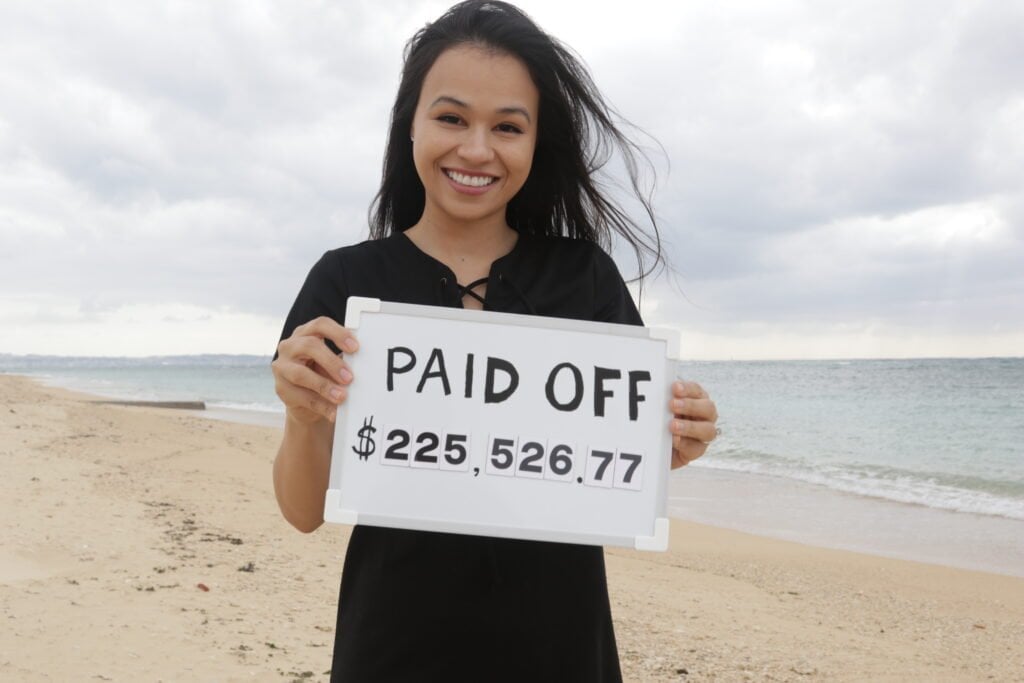
I graduated from law school with over $200,000 of student loans.
To be honest, at that time, I wasn’t even fully aware of how much debt I was in. I intentionally avoided my student loans for months after graduation–not ready to face the gravity of being weighed down by them.
Only when I started getting flooded with letters in the mail with unfamiliar terms like “grace period” and “forbearance” did I realize “wow, this is real and I need to do something about it.”
That moment of realizing I couldn’t ignore them any longer is what set me on the path to paying off my student loans. I spent hours diving in and learning everything I could about them. I listed out all of the loans I had and mapped out a plan for how I could pay them off. I was fortunate enough to have a well-paying job right out of law school, so I calculated that if I continued to live the same frugal life that I lived as a student and didn’t increase my spending at all, I could pay off the loans in 2 years.
For the next 2 years, I was laser-focused on paying off my loans.
Having a set goal for when I would be debt-free was the most motivating thing–it helped me to see that there was an end in sight. Throughout those 2 years, I had a bi-weekly ‘meeting’ with myself to make sure I was on track for my goal. Creating an ambitious goal like that also forced me to take budgeting seriously.
The single best thing I did that helped me pay off my student loans quickly was not to inflate my lifestyle. It’s easy when you go from being a broke student to suddenly having an actual income to want to inflate your lifestyle to reflect that increased income. There’s this sense that you deserve the nice purse or the glamorous vacation because you’re working and earning money now. I think there’s also a natural inclination to want to ‘fit in’ with your working colleagues that might be spending on nicer things.
I made a very conscious effort to never allow myself to think I wasn’t still a broke law student. Once you do get into the habit of spending more and treating yourself to nicer things, it’s very hard to take those things away. That’s just human psychology–it’s easy to inflate your lifestyle but very hard to come back down. On the other hand, if you can force yourself to not spend more than you were spending as a student, it’s easier, because then you’re just maintaining the status quo.
My guess is that I was probably the only one at the fancy law firm who was wearing shoes from Walmart at work and walking 35 minutes each way to and from work just to save a few dollars on the train fare, haha! By not inflating my lifestyle, I was able to save over 80% of my income to put that towards my student loans. I also credit refinancing my student loans–it enabled me to slash my interest rate in half and save thousands of dollars in interest.
3. How long have you had a YouTube channel?
I started my YouTube channel a little less than a year ago.
I posted my first video on October 31, 2019.
4. Why did you decide to start a YouTube channel?
I wanted to start a YouTube channel as my small way of trying to have an impact. I had just left the law firm to start Plug and Law, and was looking for a ‘passion project’ that would fit 3 criteria: it needed to be completely unrelated to law, outside of my comfort zone, and have an impact on people.
Learning about personal finance changed my life. It allowed me to pay off over $225,000 of student loans and save up enough money to leave a comfortable job to pursue entrepreneurship. I wanted to find a way to share that passion of personal finance with others to hopefully enable and inspire them to take control of their finances in order to live a more fulfilling life.
At first, I thought about starting a blog to talk about personal finance. I have always enjoyed writing and a blog would’ve fit perfectly within my comfort zone. However, as I spent more time thinking about what platform I wanted to use to get my message out there, the idea of creating a YouTube channel started to seem more appealing.
One, it was completely out of my comfort zone. I’ve always been camera-shy, have a fear of public speaking, and the idea of recording myself was terrifying, but I made a promise to myself after I left the law firm that I wanted to stop letting fear control me. For too many years, I’d let fear of judgment, fear of failure and fear of disappointing my parents dictate the things I did and didn’t do in life. Leaving the law firm was already a terrifying jump out of my comfort zone, so YouTube seemed like a great way to challenge myself even further.
Two, I liked that there was a higher barrier to entry. I think blogging is slightly easier to start because you are just typing behind a computer and can even remain anonymous. To me, it felt was blogging was already too saturated and it would be hard to get my content to reach people. For YouTube, on the other hand, you’re putting yourself in front of a camera. It’s vulnerable. I felt like, perhaps for that reason, YouTube wasn’t as saturated. While there were quite a few men who seemingly dominated the personal finance space on YouTube, I didn’t see many women in the space–so thought I could perhaps contribute from that perspective as well.
5. How do you make money with a YouTube channel?
I make money with my YouTube channel through 3 primary sources:
- Ad revenue
- Affiliates
- Sponsorships
Ad revenue is money earned directly through Google. After you reach a certain threshold (1,000 subscribers and 4,000 hours of watch time in the last 12 months), Google allows you to apply for the YouTube Partner Program. Once accepted, you can run ads on your YouTube channel and earn money from the ad revenue. Google keeps 45% and you get 55%.
The amount you can earn from ad revenue varies largely based on the topics that you cover. For example, finance channels typically earn much more for every 1,000 views compared to gaming channels. Just to give you a sense, this video I made about how I’ll build $200,000 of passive income this year starting from $0 currently has a $55 CPM (CPM = how much an advertiser pays for 1,000 views). In stark contrast, a gaming channel’s CPM averages between $2-3.
It took me almost 6 months to reach the threshold to apply for the YouTube Partner Program. It took me about 3 months of consistently uploading a video each week to reach 1,000 subscribers, but then I didn’t reach the required 4,000 hours of watch time until the end of April, after my first viral video. From the momentum of that viral video, I earned over $700 from Google ad revenue on the first day that I was able to run ads on my channel.
The second YouTube income source is from affiliates. With affiliate marketing, I can promote certain services or products I genuinely like to my YouTube subscribers, and if they click a tracking link known as an affiliate link to take further action (i.e., to purchase the product), I may receive a commission.
Thirdly, I get paid for creating sponsored videos on my channel. A sponsored video is where a company will pay me a set amount to mention their product or service in a video. The most common type of sponsored video seems to be a 60-second integration, where I talk about their product or service for 60 seconds of the video.
I don’t really think of this as YouTube income, but a fourth way I also indirectly make money from my YouTube channel is through my subscribers purchasing my digital products and services at Plug and Law. I offer legal templates (i.e., Privacy Policy, Terms & Conditions and Disclaimer for your website) and also a Trademark service (filing your trademark application with the USPTO), so many of my subscribers have also become Plug and Law customers.
6. How has your following and income grown since you started?
In less than a year, I’ve gone from 0 YouTube subscribers to making over $100,000 from YouTube (just from ad revenue, affiliate marketing and sponsorships). The large majority of that income has come in the last 5 months.
My goal with YouTube was always to post 1 video per week, for 1 year, no matter what–regardless of how many views or subscribers I had. I think that it’s important with YouTube to set goals that are output based since those are completely in your control. If you set goals about the number of views or subscribers you want, you could be setting yourself up for disappointment since those aren’t entirely in your control.
As far as following, it took me 3 months to get from 0 to 1,000 subscribers, then around another 2.5 months to get from 1,000 to 2,000 subscribers. Then, thanks to a few viral videos, I went from 2,000 subscribers to over 50,000 in 30 days. My channel is currently at over 70,000 subscribers and 4 million views.
For the income, in January, I made a video saying that I was going to make $200,000 of passive income in 2020, starting from $0. I was fascinated with the idea of creating passive income, especially coming from a corporate law background where I truly was trading my time for money. The crazy thing is, the world of making money online was completely foreign to me a year ago at this time.
For the $200,000 passive income goal, I had 4 important factors I was considering:
- It needed to have a motivation besides money. I think it’s important to have a mission statement behind everything you do–it can’t be just for the sake of making money. Otherwise, it’s too easy to burn out. For Plug and Law, my mission statement is making the ‘legal stuff’ simple and accessible for business owners and entrepreneurs. For my YouTube channel, my mission statement is helping people learn how to make more money, save more money and take control of their personal finances.
- It had to be efficient. Anything that I could outsource to enable me to scale the business more quickly, I would outsource. An example of this is that I outsourced video editing of my YouTube channel from the beginning.
- It must be passive. It cannot be tied to the number of hours I’m putting it. That means turning down opportunities like 1-1 coaching or consulting.
- It needs to be location independent. I want to build a business and income where I can live wherever I want. Growing up with a dad in the U.S. Air Force, we moved around every 3 years, so by the time I was 14 we had already lived on 3 different continents. I love the idea of building a sustainable business where I’m not tied down to one specific location.

The funny thing about my income projection is how far off my YouTube predictions were.
In January, I had made $0 from YouTube, and predicted that in 2020 I would make $15,000 from ad revenue, $2,000 from sponsored videos, and $3,700 from affiliates.
At the time, I had people telling me that was absolutely ridiculous and I would never be able to hit that in my first year on YouTube. To my surprise, I made that amount from YouTube (around $20,000) in just the month of May alone.
It even caught the attention of Business Insider–they did an article about how I was able to grow on YouTube so quickly.
7. What do you use to record, edit, and publish videos?
I use a Canon 80D camera to record and Adobe Premiere Pro to edit.
I hesitate to share that because I don’t want people to think you need an expensive camera or editing software to succeed on YouTube. I don’t think that’s the case.
For the majority of people, I would recommend just starting with your phone and free editing software for the first few months before making any big investments.
8. How long does it take you to make each YouTube video?
It varies. From start to finish, some videos can take me up to 15 hours.
This is especially the case if there’s a lot of background research required. The quickest I can do a video is about 3 hours, and my average is probably around 8 hours.
There are 3 stages of creating a YouTube video: scripting, filming and editing.
The large majority of my time is spent scripting. Filming takes me between 30 minutes to 1 hour, now that I’m more experienced. In the beginning, I was still very nervous in front of the camera and stumbling over my words, so it would take me over 2 hours to film one video. Editing, since I’ve outsourced, takes me the least amount of time–it just requires me to create basic editing notes for my editors and approve the final edit.
The amount of time I spend on each task also reflects the value I assign to it.
Without a doubt, I think the most important aspect of a YouTube video is the scripting. With every video, I want to make sure I’m providing a lot of value in the video, and the way to accomplish that is by spending a significant amount of time preparing the content. Filming and editing to me are lower priorities. People will come back to your channel if they’ve gotten lots of value from your content. I don’t think filming and editing are the key things that bring people back.
9. Would you say that you’re a techy person? Do you have a film background?
No, I’m not techy and don’t have a film background.
I taught myself how to edit using Adobe Premiere Pro by just watching YouTube videos. Even if you do end up outsourcing video editing like I did, I think it’s still important to have a basic understanding of how to edit videos so you know how to hire the right editors for your needs.
10. What do you like about making YouTube videos? What do you not like?
The best part of making YouTube videos is hearing the words “Erika” and “inspiring” in one sentence. I talk about this on my channel sometimes–I spent years and years working to go to the best college, then the best law school, and the best law firm, and never once heard those words together. To me, that is the greatest part of YouTube. You get to connect with a real audience and try to have a real impact. That’s not something I don’t think I could have ever achieved had I just stayed confined in my corporate law bubble.
I especially love hearing that I’ve helped people with their finances. The other day someone messaged me on Instagram and said I inspired her to finally take control of her student loans. That was really rewarding.
The difficult part about YouTube is dealing with negative comments. I don’t think I was prepared for that–especially comments about things I can’t change about myself. Those do impact me, but I try to remember that in order for a complete stranger to lash out at me like that, they must be going through something or having a bad day. As much as possible, I try to respond to even the negative comments with kindness.
11. Do you think there is room for new YouTubers?
Yes, absolutely.
I see a huge opportunity for business owners to use YouTube as a way to establish themselves as experts in their field and gain visibility and credibility for their business.
I believe there’s always going to be room for new YouTubers. Come to YouTube with a plan on how you’re going to provide value to your audience, stay consistent, and you will succeed.
12. What tips do you have for someone wanting to start a YouTube channel?
The hardest part of YouTube is starting and the second hardest part is staying consistent. Both of those are entirely in your control.
I know that starting YouTube was really hard for me. I was told by other lawyers that it would ruin my professional image, and I knew that I would be judged. Getting over that hurdle was the toughest. But, once I posted my first video, it was out there in public! No going back from there, so I figured I might as well embrace it.
The second hardest part is going to be staying consistent. The primary differentiating factor between people who succeed on YouTube and people who don’t is the work ethic. How consistent can you remain, even when the views and subscribers aren’t necessarily where you’d like them to be?
If I had to capture the ‘secret’ to succeeding on YouTube in one sentence, it would be: ‘You should love it like a hobby, but treat it like a business.’
Whatever topic you choose to talk about on your channel, make sure it’s something that you’re truly passionate about. You need to love it like a hobby–meaning, you’d want to do it regardless of whether income comes from it. For me, I knew personal finance was something I could talk about for years, even if I didn’t make a single dollar from it. This matters because there are going to be times when you get discouraged by YouTube. Maybe you’re not where you want to be in terms of subscribers, or a video you spent hours creating only got 5 views, or someone writes a negative comment about you. However, if what you’re talking about is something you’re genuinely passionate about, you’ll keep going! If you come to YouTube just motivated to make money, it’s going to be hard to sustain.
Second, you need to treat it like a business. Since consistency is incredibly important for YouTube, treating it like a business means not just posting a video whenever you feel like it. You need to have a consistent upload schedule and stick with it. Whether it’s once a week or twice a week, come up with a plan for how often you want to post a video on YouTube, and stay consistent with it for at least a year.
The reality is, most people will quit YouTube before they even see success or get their first viral video. If you can stick with it and stay consistent, I do believe anyone can find success on YouTube. It does require patience, but you will have your breakout moment! For 6 months, I made a video a week and only saw slow growth. My videos were averaging about 200 views at that time. Then, right before the 6 month mark, I got my first viral video with over 20,000 views. The week after, I got my second viral video, with over 800,000 views. It will happen for you if you can stay patient and consistent!
Another tip: to truly monetize on YouTube, you also shouldn’t just rely on ad revenue alone. Only a fraction of my YouTube income comes from ad revenue–the bulk comes from affiliates and sponsorships. In that sense, I approach YouTube like a business. I am constantly seeking out opportunities for affiliates and sponsorships and not just waiting for them to come to me.
If you’re ready to get started, download my free step-by-step YouTube guide on how I grew from 0 subscribers to over $100,000 on YouTube in under a year.
Do you want to start a YouTube channel? What other questions do you have about making money on YouTube?
The post How I Grew From 0 Subscribers To Over $100,000 On YouTube In Less Than One Year appeared first on Making Sense Of Cents.
from Making Sense Of Cents
via Finance Xpress
My very first investment was in a certificate of deposit when I was a teenager. CDs back then paid more than 10%. While we can’t get that kind of return today, a certificate of deposit is a safe place to hold cash. Here’s our list of the best CD rates.
 We’ve evaluated more than a dozen traditional and online banks and more than 100 certificates of deposit. The best CD rates come from online banks. They beat their brick and mortar competitors by a country mile. Below you will find banks that offer terrific CD rates.
Our Top Picks
Ally Bank High Yield CD – terms of three months to five years; no minimum deposit Ally Bank earns our top pick because it consistently pays top rates on CDs. It offers accounts with no fees and no minimum balance. Opening an account is quick and easy. There is no balance required to get the top rate. Ally Bank is a FDIC-insured financial institution, so your money is safe up to the FDIC insurance limits. CIT Bank No Penalty CD – 11-month no penalty CD term; 2.05% APY; $1,000 minimum deposit
  If you’ve been paying attention to CD rates lately, you know they’ve been going up. CIT has taken it one step further by offering an 11-month no-penalty CD with a 2.05% APY. This is a great rate for a short term, and the minimum deposit required is only $1,000.
We Know Certificates of Deposit
I’ve invested in certificates of deposit since 1979. I can recall earning more than 16% on a 6-month CD. Today I still use CDs to hold our emergency fund and track CD rates daily both here and for Forbes. The Dough Roller editorial team represents more than 50 years worth of experience when it comes to certificates of deposit. We’ve used that experience and countless hours of research to help you find a great CD.Best CD Rates Updated Daily
Here’s a list of current CD rates. These rates are updated throughout the day:Featured Certificates of Deposit by Term
Shopping for a CD takes more work than looking for a savings account. The reason is simple. Rates changed based on the term of the CD. One bank might have a great 1-year rate, while another bank may be the best at three or five year CDs. Given this, we’ve listed here some of the CD rates based on the term. Synchrony Bank–Term: 3 months to 5 years; Rates: 0.75% to 2.55% APY; $2,000 minimum deposit to open Synchrony is a fairly new name in the online banking world, but it has an old history. Formerly GE Capital, Synchrony is the world leader in private label credit cards (think Walmart, Amazon, Lowe’s etc.). Synchrony Bank offers CD term rates from three months to five years. They also offer IRA CD terms of the same length. Both IRA and standard high-yield CD rates are the same. And Synchrony bank also offers other deposit products. Included in their product line are Money Markets, High Yield Savings, and IRA Money Markets.
- Best Synchrony Bank CD–12-month high-yield CD that currently pays 2.35% APY ($2,000 minimum opening deposit).
CIT Bank–Term: Up to 5 years; Rates: Up to 2.40% APY; $1,000 minimum deposit to open
Founded in 1908, CIT Bank has more than $50 billion in assets. An FDIC-insured financial institution, it offers CD terms up to 5 years. It does require a minimum deposit, but at $1,000, it’s manageable for most savers.
Discover Bank–Term: 3 months to 10 years; Rate: 0.35% to 2.30% APY; $2,500 minimum deposit to open
 Discover Bank first opened its doors in 1911 in Greenwood, DE. Originally known as the Greenwood Trust Company, the bank joined Discover Financial Services in 2000. Discover is best known for its credit card line of products. But they also offer a wide range of CDs. I personally own a 10-year IRA CD, which I locked in many years ago at a rate of 2.70% APY. And now, the interest rate is slightly reduced at 2.30%
Ally Bank–Term: 3 months to 5 years; Rate: 0.75% to 2.30% APY; no minimum deposit to open Ally continues to win awards for outstanding customer service and is always at the top of the list for interest rates.
 Ally continues to win awards for outstanding customer service and is always at the top of the list for interest rates. Personally, I have a few different Ally deposit accounts. Even though their rates change frequently, I appreciate the service and quality of its website. Formerly GMAC, Ally continues to re-brand itself in a positive direction. Ally Bank offers CDs in a variety of terms, including two that are fairly unique to the space. They have a no-penalty CD that allows you to withdraw your funds at any time after 6 days from funding the account without paying an interest penalty. They also have a raise your rate CD that allows you to increase the interest rate twice on a four-year CD term (so you’re not locked into a lower rate).
- Best Ally Bank CD–12-month High Yield CD that currently pays a 2.10% APY
Barclays –Term: 3 months to 5 years; Rates: 0.35% to 2.25% APY; No minimum balance to open
 The oldest bank on our list, Barclays Bank was founded back in the 1700’s in England. It has come across the pond to offer extremely competitive credit card and deposit products. Barclays Bank has a fairly standard set of CD terms, ranging from three months to five years. Unlike others on this list, there is no minimum balance required to open a certificate of deposit with Barclays.
- Best Barclays Bank CD–12-month high-yield CD that currently pays 2.25% APY
Marcus Bank–Term: 6 months to 6 years; Rate: 0.60% to 2.50% APY; $500 minimum deposit to open account
 Marcus–Headquartered in New York, Marcus is named after it’s founder; Marcus Goldman (Goldman Sachs USA). They offer a relatively slim product line compared to other banks on this list. Customers have a choice between an online savings account or certificates of deposit. CD rates start at the six-month length and work all the way up to six years. The minimum deposit to open up a Marcus CD is $500. Also included on all CD accounts is a 10-day rate guarantee. This means that if you open an account and the rate goes up immediately, you get the new, higher rate.
- Best Marcus USA CD–12-month high-yield CD that currently pays 2.40% APY
- Marcus Savings Account – $1 minimum deposit with a 2.00% APY
3 Things to Consider When Comparing CD Rates
Penalties–You will lose interest if you don’t hold the CD for the whole term. Many of the above banks charge 60 days of interest as a penalty for requesting your money early and some can go as high as nine months! If you’re someone who needs liquidity, then creating a CD ladder is your best option. For example, instead of investing $25,000 into a single 5-year CD, you can invest $5,000 into a five year CD every year. So after five years, you’ll have $5,000 of liquidity + interest to either take out, or re-invest. Of course, you can always choose a no-penalty CD, as we’ve covered above. Check Local Banks and Credit Unions–Even though the banks you see above make up the majority of online deposits in the United States, a local bank or credit union can sometimes, do better. Local banks and credit unions may not have the manpower or the marketing dollars to attract millions of clients. But that’s the very reason they might be able to attract you. Low overhead costs and local advertising budgets mean more value in the products they’re offering. This, of course, doesn’t mean they’re all winners (my parents refuse to listen to me about their 5-year 0.35% CD for example) but it does mean you should explore the banks in your community. CD Alternatives – Investing your money into something with less than a 2% return takes some stomaching. The rates you see above are guaranteed for the length of the term and are FDIC insured up to $250,00 per depositor so there is no risk. That said there are a bevy of other places to park your money for a better return … if you’re willing to take on a little risk.- Peer to Peer lending platforms like Prosper and Lending Club average annual returns of 5% – 7%. Greater than 95% of their notes return profits.
- Robo investing is a great way to park your money and let qualified investors to the heavy lifting. The fees are typically under 1% of your investment annually and the returns average greater than 5%. Two highly regarding companies are Betterment and M1Finance.
- Real Estate Crowdfunding is fairly new and allows you the chance to invest in real-estate with a relatively small amount of money. Places like RealtyMogul, Fundrise and RealtyShares are free to sign-up and again charge a small percentage of investment fee for annual returns in the 8% – 10% range.
The post The Best CD Rates of 2020 (Updated Daily) appeared first on The Dough Roller.
via Finance Xpress


Two years ago, I was unsatisfied with my options for health insurance. The premiums were rising even as the quality dropped in the form of an ever-increasing deductible. I am guessing that you might feel the same way these days – most of us Americans are in the same boat.
I felt like I was being squeezed from both ends and it was starting to piss me off. So I decided to take some action, by doing the math for myself using a spreadsheet. I needed to answer the question, “Is this insurance really as bad a deal as I think it is?”
Sure enough, the risks and rewards of the coverage did not justify the premiums, so I decided to try an experiment and simply drop out of the market and insure myself. In other words, just rolling the dice and going through life with no form of health insurance at all.
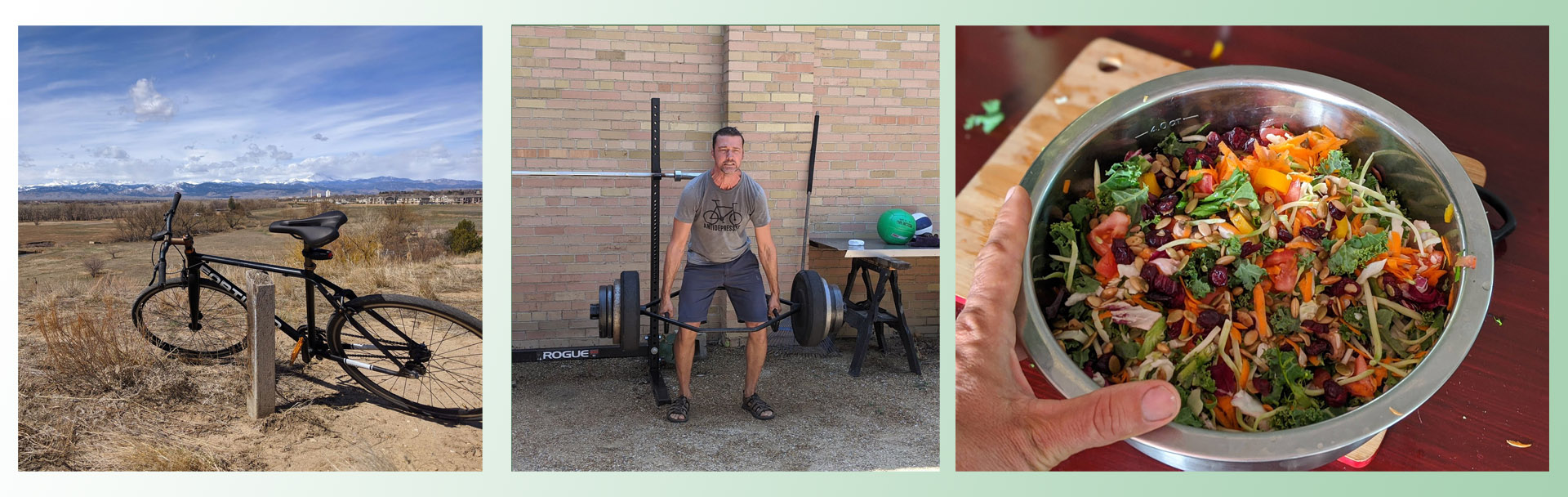
Doubling down on the bikes, barbells and salads, I did my best to eliminate any risk factors that are in my control, while accepting that there are still much less likely but more random factors that are not.
Almost two years and $10,000 in premium savings later, I have found the experiment to be a success: I have slept well and not worried about the fact that I could be on the hook for a big bill if I did ever need major care. And as luck would have it, I also enjoyed the same good health as always over this time period – probably the best in my life so far because the extra healthy living has been working its magic.
But.
This situation has not been quite ideal, because my life is not a very useful model for everyone to follow. Most people don’t have the luck of perfect health, many have a larger family than I do, and very few people are in a financial position to self-insure for all possible medical bills.
Also, I found myself wishing I had a doctor that actually knew me, who I could call or visit on short notice if I ever did need help.
Finally, I wanted to switch back to having some form of insurance so that I could learn about it and write about it as time goes on. But was I really willing to be part of that unsatisfying and broken insurance model?
Then something magical happened: I learned about the new and vastly improved world of Direct Primary Care physicians.
What is DPC?
DPC is a fairly new trend in the US, but it is also a return to a very old tradition: a direct relationship between you and your doctor, with no insurance company in the way.
As a customer, you pay for a monthly subscription (somewhere around $100), and in exchange you get unlimited access to super elite, personalized medicine for the vast majority of your medical needs. Diagnoses, prescriptions, skin conditions, stitches, even fixing a broken bone if you don’t need surgery. All covered, with no co-pay and in an environment that feels to me like Presidential-level health care, in striking contrast to some of my past experiences where I felt like an anonymous numbered ticket in a sloshing sea of bureaucratic institutional medicine.
Oh, and direct email, phone and text message contact with your doctor, prescriptions over phone or video call, and in some cases even house calls depending on the practice and the situation.
Through some sort of magic, the Direct Primary Care model offers much better medical care and much lower prices, at the same time.
How could it be? It’s because of the incentives.
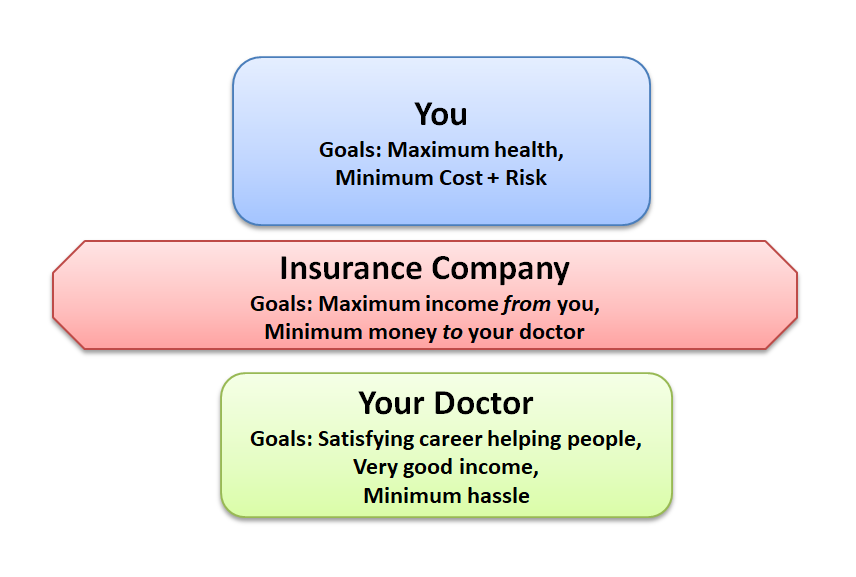
In our famously broken US healthcare model, an insurance company is wedged in between you and your doctors, and it has different objectives than you do.
You just want the best overall health for yourself, and when the shit does hit the fan and you need medical care, you want it to be quick, effective, and at minimum cost. And you don’t want to be hounded with years of stressful stray bills after an expensive medical procedure.
Your Doctor wants to help as many people as possible and make a good living, without having to wade through a sea of paperwork or stress or lawsuits.
Your Insurance company wants to make as much profit as possible, which means maximizing the amount they collect from you, and minimizing the amount they pay to your doctor. In theory, they benefit from helping you to stay healthy. But they have also developed elaborate contracts (putting in as many loopholes as possibkelots of loopholes to allow them to drop your coverage or deny claims), become masters of delaying payments, limiting which procedures and tests they will authorize doctors to do, and just generally throwing the biggest monkey wrench into the system that they can.
Over the decades, there has been a complex battle of lawmaking, lobbying, compromise and complexity to try to regulate away some of these problems. Sometimes the new laws help, sometimes they don’t, but the end result will never be optimal simply because there are a lot of people involved, and big crowds of humans make for slow and shitty decision making.
The Direct Primary Care Model

With DPC, it’s just you and your doctor. You both have the same incentives, but now the model works much better because there is no chaotic and expensive force in the middle to mess things up.
And because you operate on a subscription, the doctor gets paid whether you come into the office or not. At the same time, you are free to come in whenever you do need something, at no additional cost. So she has an incentive to keep you healthy, so that you have no need to come into the office in the first place.
On top of this, you get to decide together what is the best course of healthy prevention and treatment, without the overhead and complexity of constantly fighting with insurance companies. This drastically cuts the costs by eliminating the large staff of paper-pushers and attorneys that you normally need to operate a medical office, and frees up the doctor to spend more time with each patient during each visit.
How could the doctor possibly make a living with such low fees?
As it turns out, a small practice with a full-time doctor and 2-3 credentialed medical assistants can handle over 1000 subscribers while still giving each person much more time than they get under the old model. At $100 per month, this is $1.2 million in annual gross subscriber income, which is enough to pay everybody well, and rent a suitable clinic space. And as you scale up the operation, some economies of scale on things like space and equipment make it even better.
Just as importantly, running a practice like this tends to make a dramatic improvement in a doctor’s quality of life. It’s better medicine, with more flexibility and less hassle and stress. No wonder this model is growing rapidly and has become a favorite of physicians who happen to be MMM readers, as I hear from more of them every month.
Direct Primary Care is now a nationwide movement, with many hundreds of practices spanning the country and many more opening each year. Today’s screenshot of https://mapper.dpcfrontier.com/ shows the current state of the market.

In fact, it turns out this whole trend might even be a Mustachian-originated phenomenon, as I joined my own local practice called Cloud Medical, met the founder Dr. David Tusek, and he revealed halfway through our introductory visit that he was both a founder of DPC pioneer Nextera Healthcare in 2009, and a lurking reader of this blog for several years before I discovered him right here in my own town.
A note for locals: if you are considering joining Cloud, mention that you would like the MMM discount to save a further $12/month! (we have no affiliation, they are just looking to expand the practice and I’ll remove this notice if they fill up)
My experience (so far) with Cloud Medical
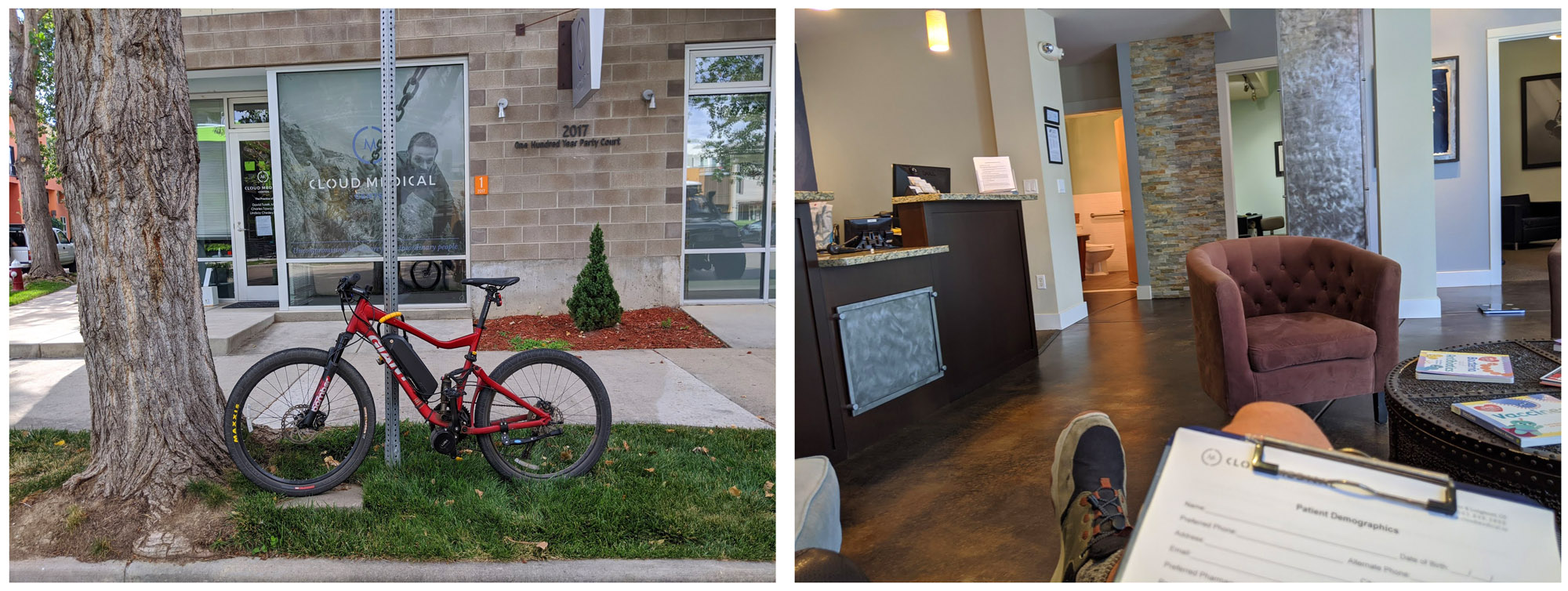
I signed up with Cloud this past summer, about five months ago. Although I have been feeling great, I figured it was time to put myself through an extensive battery of “middle-aged man” tests just to make sure I am not missing any hidden problems.
With the doctor’s guidance, I did a very thorough blood test, plus an electrocardiogram scan of my heart performance and ultrasound Carotid artery scan which involves a practitioner lubing up your neck and sliding a Star-Trek-style probe around on it while recording images of your body’s most critical plumbing to check for signs of clogging. Plus the usual checks of an annual physical exam. All clear.
I also finally got around to a long-awaited diagnosis and prescription for my Adult Attention Deficit Disorder condition, something which took me seven years to get organized enough to achieve, paradoxically one of the crippling effects of ADD. Although this is a very personal health detail, I mention it here because there are many friends and readers who also suffer from this condition, and I encourage you to learn more about it and seek help if appropriate. It can be life-changing. I found this process was much easier in a DPC environment, because of the more personal nature of the doctor-patient connection.
This DPC model addresses perhaps 90% of typical medical needs in-house, and a “menu” of optional specialists knocks out another 5%.
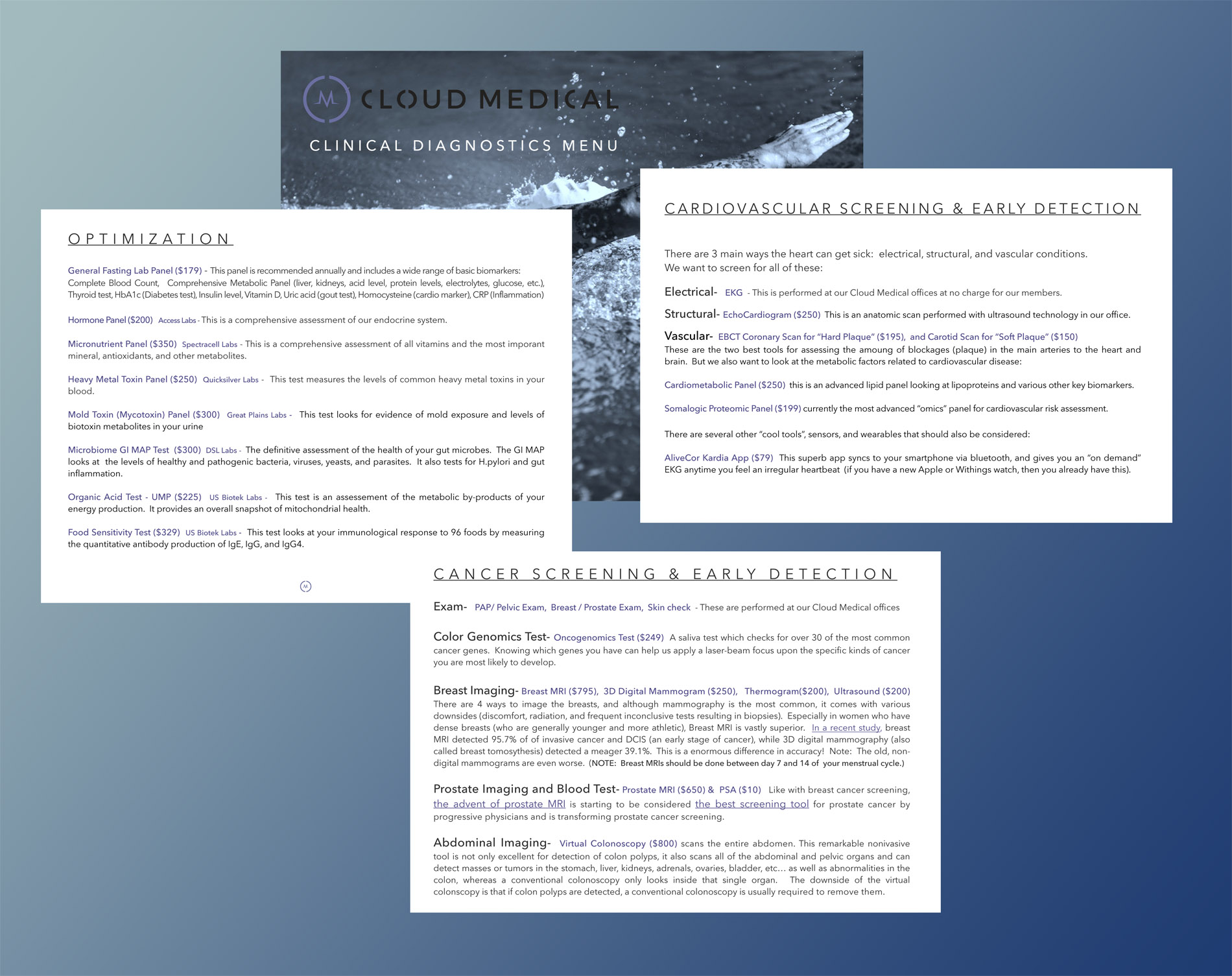
But there is still a chance you will need the more rare (and expensive) services of a hospital or specialist. In this case, your DPC physician can provide referrals and guidance to allow you to get the right help at a discounted, direct-pay price, or even handle your needs with a conventional insurance company.
Part Two: But What About Bigger Expenses?
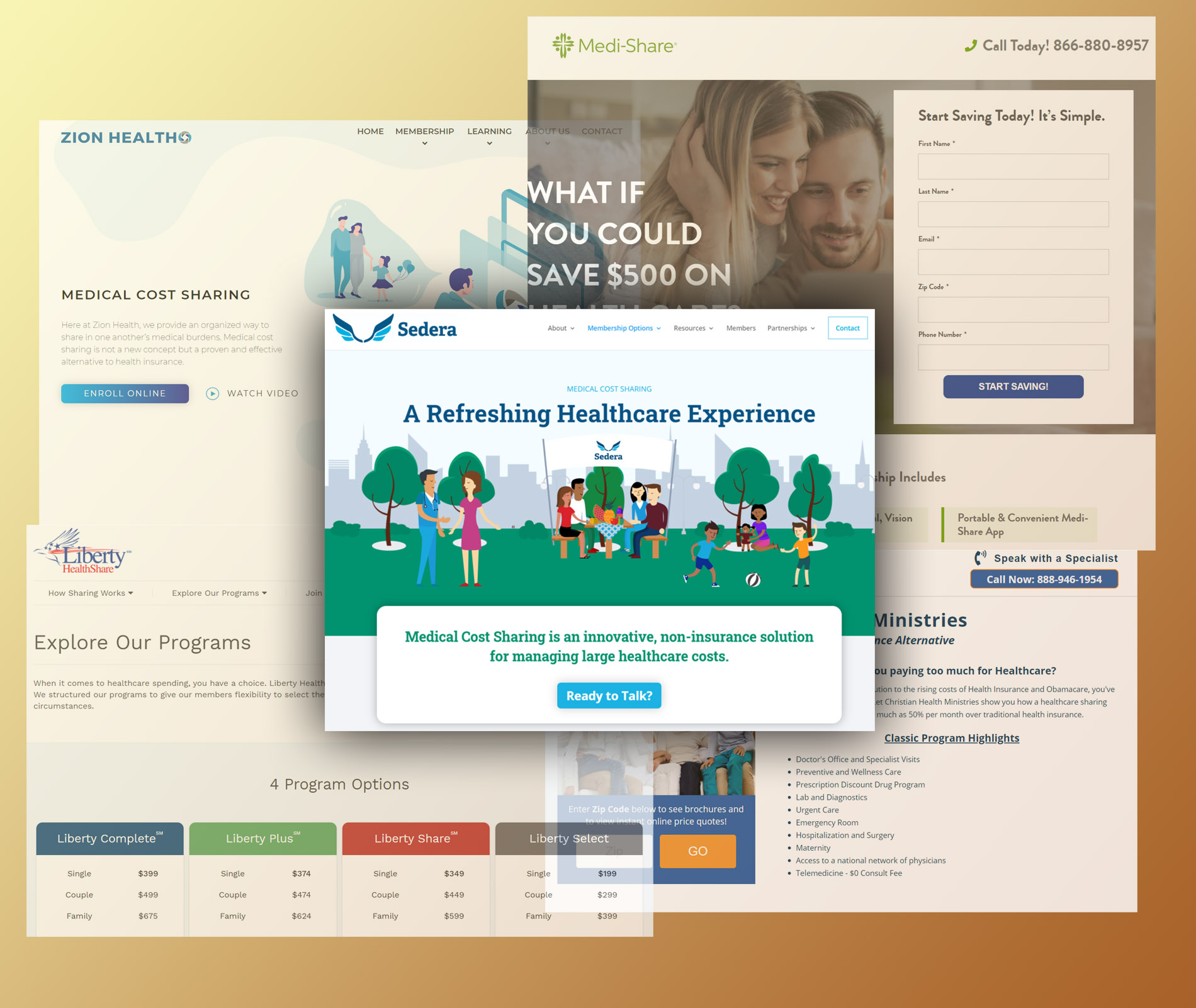
At this point, you can add another layer of protection: High deductible conventional insurance, or a health share plan which offers a similar end-result while being careful not to be classified as insurance.
These plans started out catering only to members of certain religions. Then a provider called Liberty Health Share opened up the market slightly while still requiring some fairly specific spiritual affirmations.
The latest incarnation is a company called Sedera* , which has addressed some of the shortcomings of earlier companies, has no religious basis, and now seems to be the place that most of my more analytical friends and their families are ending up. Even my DPC physician Dr. Tusek is now recommending Sedera.
Sedera is worth a whole separate article in itself, and in fact I am starting a dedicated page for questions and answers and discussion on the experience. But for now, we’ll take a shortcut and just say that I was convinced and willing to give it a try, so I signed myself up as a Sedera customer.
A quick comparison of the closest standard insurance plan I could find on the standard Colorado health insurance exchange, versus what I got from Sedera (click for larger version):
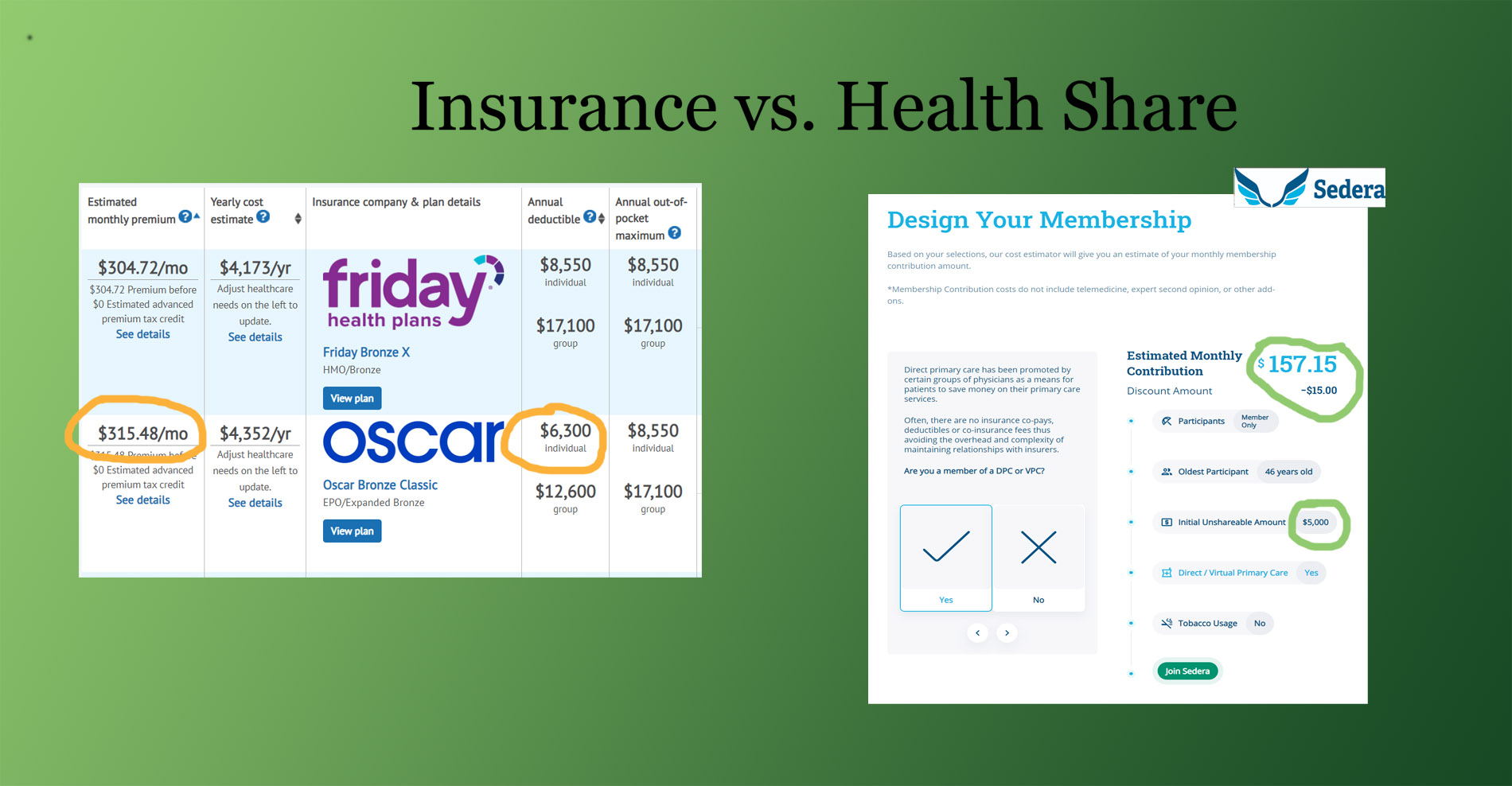
Another thing I like about all this is that there is no concept of “in network” and “out of network” doctors or hospitals. You can even use hospitals in other countries while traveling, and get reimbursed in US dollars after you return home. It’s simpler, cheaper and more flexible.
So in the end, by combining DPC with a health share plan, I am hopefully ending up with the best of all worlds:
- The best personalized, advanced medicine and quick response time, possibly anywhere in the world through my DPC subscription, with unlimited “free” (zero co-pay) doctor visits.
- Flexible coverage for any additional needs and support for decision-making and billing, even when traveling internationally
- A financial backstop just in case things get really expensive
- At a total monthly cost that is still lower than the most basic ho-hum plan on standard insurance
- A further bonus – Sedera incentivizes you to be a member of a DPC, with a solid discount if you are, because they know their costs to cover you will be lower if you are healthier and have hassle-free access to a doctor.
This all sounds good to me, but it is important to state that this is an experiment. I still don’t have much experience with the US healthcare system – it helped deliver my son in 2006, and then repair that same boy’s broken arm in 2016. Conventional insurance offered some halfhearted support for both of those expenses, but aside from that I don’t have many stories to tell.
By collecting more information from readers and from my new helpers at Cloud Medical and Sedera, we should be able to make more sense of all this. And hopefully continue to expand and improve this new, better form of health care so it is accessible to more US residents.
If it gets big enough, we might end up solving this whole problem together – better, cheaper health care for everyone.
My past articles and experiences have shown that for many of us, a big hurdle when considering early retirement or self-employment is “what about health insurance”? Hopefully the is DPC + Healthshare method will put that question to rest for many of us. After all, shouldn’t our career and life choices be separate from our healthcare?
—–
Interested in Learning More?
A long-time friend of mine (and fellow early-retiree, and co-owner of the HQ coworking space) Bill and his family have been Sedera customers and enthusiasts for about two years. So much that he even took it upon himself to meet the company’s management, sign himself up as a representative to streamline some of the inefficiencies he perceived when joining, and then teach me about the whole thing.
Because of that, I am sharing Bill’s Sedera signup link in this article. His is unique among the Sedera affiliates in that he charges zero administrative fee, typical brokers charge $25 per month and up.
https:/sedera.community/thefireguild1
*note: Sedera does pay its affiliates a small referral fee for new customers, which does not affect your monthly bill – in fact, this link offers a lower price than subscribing directly through the company’s website. Thus, we believe this is the lowest cost way on the Internet to get this coverage.
As mentioned above, I’m giving Bill his own page to maintain on this site, where he can share his ongoing research and updates and answer questions: mrmoneymustache.com/sedera
Further Reading:
I was quite moved by this piece that Cloud Medical’s Dr. David Tusek wrote about “the ten heartbreaks” that led him to work since 2009 towards accelerating this better way to do healthcare.
An interesting story from Bill’s hometown, from a doctor who took this path way back in 2013:
South Portland Doctor Stops Accepting Insurance, Posts Prices Online
(from the Bangor Daily News)
from Mr. Money Mustache
via Finance Xpress
How can college students make money online? This list of the best online jobs for college students will show you how.
More and more people are attending college and working at the same time. This may be those who are going straight from high school to college, adults going back to college, those working towards more degrees, and so on.
I had to work throughout high school and throughout college, and I will admit that it was tough at times.
While almost all of it was in-person, hourly jobs, I would have loved to find something online instead! It would have made it much easier to balance work and school if I had a flexible, online job like I do now.
I didn’t find out about blogging until towards the end of my time at college, and I wish I would have learned about working online sooner as it would have helped me greatly.
Being able to work online would have been helpful for many reasons, such as:
- No commute
- The possibility of a more flexible schedule (so that you can build it around your school schedule)
- Being able to make money (duh!)
And more.
Being able to make money in college can help you start making payments on your student loans, have extra spending money, help you pay rent, and more. It might sound early if you’re in college straight from high school, but you could even start saving for retirement.
While I wasn’t in college that long ago, I don’t think there were as many online jobs for college students as there are today. And if there were, I had no clue they existed.
Now, there are plenty of online jobs for college students with no experience. This is really exciting if you are looking for flexible ways to make money while you’re in school.
Some of the best online jobs are work from home jobs that involve you working for someone else, or you may be able to even start your own business.
There are online jobs for college students that involve freelancing, teaching, selling stuff online, writing, and more. The jobs I’ve listed in this article are ones that allow you to pick your hours and how much you work.
This may allow you to work a little less during busy semesters and pick up extra work during breaks.
Whether you are looking to start making extra money, you’re looking for something part-time, or if you are looking for full-time income, this list of online jobs for college students in a great place to start.
Towards the end of this article, I also have included tips for managing both your college and work schedule.
Content related to the online jobs for college students:
- How I Graduated From College In 2.5 Years With 2 Degrees AND Saved $37,500
- 21 Ways You Can Learn How To Save Money In College
- Parents Paying For College – Is This A Good Idea?
- 4 Reasons You Should Go To Community College First
- How Do Student Loans Work?
Below are 16 online jobs for college students.
1. Create a website
My favorite online job is blogging, of course!
I even started it while I was in college and getting my Finance MBA. I wish I would have started my blog even sooner. I was working so many different jobs while I was in college to pay the bills, and it got exhausting.
Blogging has allowed me to travel full-time, work from home, have a flexible schedule, earn somewhat passive income, and more.
My blog was created on a whim as a way to track my own personal finance progress. And, when I first started my blog, I honestly didn’t even know that people could make money blogging or how to create a successful blog!
I did not create Making Sense of Cents to earn money from home, but after only six months, I began to make money.
You can easily learn how to start a blog with my free How To Create a Blog Course.
Here’s a quick outline of what you will learn:
- Day 1: Reasons you should start a blog
- Day 2: How to determine what to blog about
- Day 3: How to create your blog (in this lesson, you will learn how to start a blog on WordPress – my tutorial makes it very easy to start a blog)
- Day 4: How to make money blogging
- Day 5: My tips for making passive income from blogging
- Day 6: How to grow your traffic and followers
- Day 7: Miscellaneous blogging tips that will help you be successful
Out of all of these online jobs for college students, blogging is by far my favorite. It does take a little more time to start making money, but it’s very flexible and fits with any kind of schedule.
2. Help local businesses grow through Facebook
One of the better online jobs for college students to earn money is by helping local businesses advertise on Facebook.
By running Facebook ads for businesses, you can help them grow their reach and find new customers.
I had the opportunity to interview Bobby Hoyt about this subject. Bobby is a former high school teacher who paid off $40,000 of student loan debt in a year and a half. He now runs the personal finance blog Millennial Money Man full-time, as well as a digital marketing agency that he started in 2015.
I interviewed Bobby about running Facebook ads, and in this interview, you will learn:
- How Bobby started making money through running Facebook ads
- Why small businesses want Facebook ads
- How a person can find their first Facebook ads client
- How much you can make doing this type of work – the average is around $1,000 extra a month per client
Also, Bobby has a free webinar on this too. His webinar (you can sign up here) will teach you how to start this business even if you’re brand new, how to find paying clients, and more.
3. Sell items on Amazon
Amazon, the world’s largest online retailer has many, many people who sell items and earn money from home. My friend Jessica Larrew explains how selling on Amazon may be one of the online jobs for college students that would be a possibility for you.
In the first year that Jessica’s family ran their Amazon FBA business together, working less than 20 hours a week total, they made over $100,000 profit!
Jessica also has a FREE 7 day course that will teach you everything you need to know in order to start selling on Amazon. I recommend signing up for it now!
In my interview with Jessica, How To Make Money From Home Selling On Amazon, you’ll learn why this is one of the online jobs for college students you should check. This includes:
- How Jessica started selling on Amazon FBA
- What exactly Amazon FBA is
- How to choose what to buy and sell
- How much a person can expect to earn
- The positives of selling on Amazon, and more
4. Take paid online surveys
Not too long ago, one of the ways I made extra money to pay off my student loan debt was by doing paid online surveys.
No, I didn’t get rich from them, but I was able to earn some side cash by taking online surveys in my spare time.
And, I did this while I was in college too.
There were many times when I would receive an easy $100 check in the mail from completing surveys in a one-month period. The work is really easy. It can all be done from home, on your own schedule and timeline, so it’s a win-win!
Companies use surveys all the time to learn what their current and potential customers think of their products, services, and overall company. With the surveys you take, companies get valuable opinions on how to improve their products, and that’s what they are paying you for.
To increase your chances of making money, I recommend signing up for as many online survey companies as you can. I say this because individual survey companies may only send a few surveys your way each month, so the more you sign up for, the more money you may be able to make.
If this is one of the online jobs for college students at home you’re interested in, here are the survey companies I recommend:
- American Consumer Opinion
- Survey Junkie
- Branded Surveys
- Swagbucks
- InboxDollars
- Opinion Outpost
- OneOpinion
- Pinecone Research
- Prize Rebel
- Product Report Card
- Survey Club
- User Interviews
5. Teach English online
This job will only work for college students who already have their bachelor’s degree from a U.S. or Canadian university (it does not have to be in teaching – it can be on any subject). So, if you are in college working on obtaining more degrees, then this may be one of the online jobs for college students that’s an option for you.
Teach English online has become extremely popular, making it one of the best online jobs from home for many good reasons – it’s flexible, there’s a high need, and it pays pretty well.
Surprisingly, you don’t need to be a teacher to learn how to teach English online. You also don’t need to speak more than one language – you only need to speak English.
Those things make teaching English online a really great side hustle or online job for almost anyone.
The amount of money you can earn teaching English online will vary, but it’s typically around $14 to $22 per hour.
Because this side hustle is becoming popular, there are several great companies that allow you to teach English online. My top three picks are ones my readers have recommended and ones I have personally looked into:
Learn more at Make Extra Money By Teaching English Online.
6. Customer service representative
If you’re looking for more “traditional” online jobs for college students, then customer service might be worth checking out. Many large companies outsource their customer service departments to people who work from home.
Customer service representatives can be responsible for a number of things, like:
- Working at an online call center
- Working as a chat agent
- Offering technical support
- Virtual assistant tasks
- Working as a travel agent
The number of large companies who need online customer service reps is growing. Companies like Apple, American Express, UHaul, and more are now offering these types of online jobs.
7. Virtual assistant
Virtual assistant jobs are growing like crazy, and more and more companies and online business owners are looking to fill this role.
Virtual assistant tasks may include social media management, formatting and editing content, scheduling appointments or travel, email management, and more. Basically, you can get paid to do any task that needs to be done in someone’s business, but doesn’t need to be done by them.
My friend Kayla is a full-time blogger, virtual assistant (VA), and project manager who earns over $10,000 per month while working from home. She is also the founder of $10K VA, her course where she teaches exactly how you can make a consistent $10,000 per month as a virtual assistant too!
Kayla used to work a full-time job as a credit analyst, earning about $2,000 per month. She was struggling to make ends meet while paying off debt, so she started a side hustle as a virtual assistant.
Read my interview with her, How Kayla Earns $10,000 Each Month From Home as a Virtual Assistant, to learn if this is one of the online jobs for college students you’re interested in. We talk about:
- How much can a beginner VA expect to make
- How a person can find their first virtual assistant job
- The steps to become a VA
- Her best tips for being a VA
8. Write your own eBook
Writing your own eBook is a great way to make money online, and there is probably something super helpful that you could write about (even if you think otherwise!).
In fact, my friend Alyssa self-published her first book and has sold more than 13,000 copies.
She is now earning a great passive income of over $200 a day from her book ($6,500 in one month alone!).
She is also the creator of From Blog To Book, a course that will help you write, launch, and market your first book. I’ve already signed up for the course, and the expertise she shares is absolutely amazing. Some of the modules in her course include:
- Mapping Out Your Book Content
- Strategies for Writing Your Next 30,000 Words
- Where to Publish Your Book
- Tutorial: Getting Your Book on Amazon
- Design Your Book Cover
- Set Pricing for Your Book
- Create Your Marketing Plan
You can check out her super helpful course by clicking here.
If this is one of the online jobs for college students you’d like to learn more about, read How Alyssa is making $200 each day in book sales.
9. Write romance novels
My friend Yuwanda Black has found one of the best online jobs that is also super interesting. She writes romance novels, and in one month, she was able to make over $3,000!
I was able to have her write on Making Sense of Cents about her creative way to make extra money. In the article linked below, you can learn:
- How she got started writing romance novels
- How much money she has made
- Her top tips to start writing successful romance novels
- Why your novels do not need to be long (her most successful books are under 10,000 words)
- How to promote your romance novels
- How to sell on Amazon
And much more!
Learn more at How to Make Money Writing Romance Novels.
10. Start an online store
I feel like so many college students and young adults are starting online stores, and it completely makes sense. It’s something you can do from home, and there are ways to do it that don’t involve storing your inventory.
Yes, you can start your own online store, and you don’t need to have tons of experience or a lot of money to do so. Many people start with no background.
I’ve also heard of a number of students who have successfully started ecommerce stores because there aren’t any degree requirements for this option. It’s also one of the best online jobs for college students because you can work it in just 5-10 hours a week like Jen Leach, from E-commerce and Prosper, did.
I had the chance to interview Jenn, who explains exactly how to start an online store and not need to store the items you’re selling.
Jenn is a corporate mom turned e-commerce store owner and blogger.
She started her online business a little over three years ago, and since then, she has developed and grown three successful online e-commerce stores earning an average of $19,000 per month.
She is super successful despite only spending around 5-10 hours per week on her e-commerce business.
E-commerce and Prosper, Jenn Leach’s course, teaches you how to start an online store. She reveals her successful rinse and repeat formula to students in her course. It’s the same formula she uses to earn an average of $19,000 per month. This course will teach you:
- How to start an online store
- Winning e-commerce success tools
- How to turbocharge your e-commerce success
- How to start making money in THREE days
Learn more about this at How Jenn Makes Over $10,000 Monthly With Her Online Store In Less Than 10 Hours Per Week.
11. Voice over actor
This one is a little different from all of the other online jobs for college students in this article.
A voice over actor is the person you hear but rarely see on YouTube videos, radio ads, explainer videos, corporate narration, documentaries, e-learning courses, audiobooks, TV commercials, video games, movies, and cartoons.
In 2014, Carrie replaced her salaried day job to become a full-time voice over actor. People are constantly asking her how she got her start and how they can too.
So, she created a six-week online class, and it sold out. Several of her students booked voice acting jobs before the class was even over!
I was excited to learn more about this job, so I interviewed Carrie to learn:
- How she got into this interesting career field
- Who the common clients are
- How much money a beginner voice over actor can expect to make
- The positives of this job
- How to find your first job
- The costs, and more
You can read my interview with her at How To Start Voice Over Acting.
12. Resell items online
Have you ever found something that you thought you may be able to resell and actually make some money? When I was in college, I actually knew a couple of people who successfully resold items online and made a good living from it.
Melissa’s family earned $42,875 in 2015 through buy and sell flipping, and they were working only 10-20 hours per week.
Yes, just 10-20 hours a week!
And in 2016, she hit $133,000!
Some of the best flips they’ve done include:
- An item that they bought for $10 and flipped for $200 just 6 minutes later
- A security tower they bought for $6,200 and flipped for $25,000 just one month later
- A prosthetic leg that they bought for $30 at a flea market and sold for $1,000 on eBay the next day
Melissa also has a great book called 5 Ways to Get FREE Items To Resell for Profit, which teaches you how you can earn money from home by flipping items.
You can learn more at How Melissa Earned $40,000 In One Year Flipping Items.
13. Freelance writer
Working as a freelance writer is one of the best online jobs for college students because there is a growing number of jobs out there for freelance writers, and many people start with no previous experience.
A freelance writer is someone who writes for a number of different clients, such as websites, blogs, magazines, and more. They don’t work for one specific company, rather they work for themselves and contract out their writing.
My friend Holly from EarnMoreWriting.com is a very successful freelance writer and has earned over $200,000 writing online!
Her freelance writing course includes nine video modules, several printable worksheets, and awesome add-ons, too. Here are some of the things you can expect to learn if you take her freelance writing course:
- Discover the #1 most important thing you can do to get paid writing jobs
- Learn how to find beginner level jobs and move up over time
- Learn how price affects the amount of work you get
- Learn which types of jobs help Holly earn the most pay, and where you can find them
- Find out which online platforms work best for finding paid work, and how to use them
- Learn how to structure your work day to earn six figures or more
Learn more at How I Earn $200,000+ Writing Online For Websites.
14. Transcriptionist
Transcription work is a growing area of online jobs for college students. Transcriptionists listen to audio files and convert them to text.
In 2007, Janet started working from home as a medical transcriptionist. Shortly after that, she started a successful general and legal transcription business.
While running her business, she noticed a need for more skilled transcriptionists, so the idea of creating a course and introducing one of the best online jobs to more people popped up. Janet now teaches others in her online course how to transcribe online.
In this my interview, Earn An Income At Home By Becoming A Transcriptionist, we talk about:
- What a transcriptionist is
- How you can get started as a transcriptionist
- What kind of money you can expect to make
- The type of training you need, and more
15. Proofreader
Do you find yourself correcting grammar and/or cringing at common writing errors?
Maybe you even enjoy finding errors?!
If you are looking for a new job, or even just a side hustle, this may be one of the best online jobs for students to earn money. In my interview with Caitlin, Earn Money Proofreading By Becoming A Freelance Proofreader, you can find more information on how to earn money from home as a proofreader, court transcript proofreader, or a freelance proofreader.
In this interview, we talk about:
- How to get started as a proofreader
- Who the typical clients are
- What kind of income you can earn
- Whether anyone can be a proofreader or not
- What kind of training you need
- Where to find online jobs
Caitlin also has a great FREE 7 day course just for people who want to stop wasting time and start making more money with their proofreading skills. I definitely recommend that you check it out.
16. Freelancer
Freelancers are people who work for others by doing part-time jobs. A business may hire you on for one-time gigs or you may get a long-term job with a company as a freelancer.
In addition to some of the freelance jobs I’ve already mentioned (writing, proofreading, and transcribing) there are even more freelance jobs out there for people who have experience in a variety of fields, including:
- Graphic design
- Web design and development
- Video editing
- Search engine optimization (SEO)
- Programming
- Photography
This is one of the best online jobs for college students because you can use a skill you already have and start finding work on job platforms like UpWork and Fiverr.
How can a college student work from home?
Whether you are working a part-time or full-time job, balancing school and work can be tough, and I completely understand that feeling.
There are many working students in college who are able to manage both, but there are also many who struggle with it.
There are many ways to start balancing school and work so that you can graduate college while working a job.
I took a full course load each and every semester (usually 18-24 credits each semester), worked full-time, and took part in extracurricular activities. It was definitely hard, and I won’t lie about that.
However, sometimes a person doesn’t have a choice and has to do everything at once. Or, you might be choosing to multi-task and are wanting to learn how to better manage your time.
Working while you are going to college can help you not take out as many student loans, or you may be an adult who has to work to support your family while you are going to college. Either way, finding good time management strategies will help you be more successful.
Here are my tips for balancing school and work:
- Find your motivation for balancing school and work. This is important because at times it will be hard to manage both, and thinking about your motivation will give you the extra energy you need to keep going.
- Carefully plan your class and work schedule. To balance school and work with a carefully planned out schedule, you should start by researching when the classes you need are offered and start trying to eliminate any gaps that may fall between your classes. Having an hour or two break between each class can quickly add up. Also, if you happen to have time off between classes, using that time to do your homework and/or study can really help.
- Another time management tip is to try and put as many classes together in one day so that you aren’t constantly driving back and forth between school, work, and home. Balancing school and work can be hard, but it starts with creating a schedule that uses your time efficiently.
- Eliminate any time that you’re wasting. The great thing about finding an online job is that you’ll eliminate your commute time, which can be a huge help!
- Have a to-do list and a set schedule. This one is a no-brainer!
Please head to 9 Ways To Successfully Balance School And Work to learn more.
What is the best online job for a student? Which is the best online jobs for students?
With so many online jobs for college students, you are probably wondering which is best. I believe the best one is what works for you. Think about what things you’re interested in, what skills you are learning or already have, and how much time you want to spend learning new things.
There are online part-time jobs for college students, full-time jobs, work from home jobs for college students, remote jobs for college students, and more.
No matter which job you choose, deciding to work in college can help you in so many ways, and finding an online job has even more benefits.
What do you think are the best online jobs for college students? Do you want to work online from home?
The post 16 Best Online Jobs For College Students & How To Start appeared first on Making Sense Of Cents.
from Making Sense Of Cents
via Finance Xpress